
Thailand's manufacturing industry is one of the key drivers of the country's economy, covering sectors such as automotive, electronics, food processing, rubber and plastics, chemical manufacturing, metal fabrication, logistics, and consumer goods. As manufacturing operations become more advanced, employers must also strengthen workplace safety practices to protect their workforce and comply with occupational safety requirements.
One of the most effective ways to reduce workplace injuries is by providing employees with the appropriate Personal Protective Equipment (PPE). PPE serves as the last line of defense against workplace hazards, helping minimize the risk of injuries when engineering controls or administrative measures cannot completely eliminate potential dangers.
However, selecting PPE is not simply about purchasing safety equipment. Employers must understand the hazards associated with each work activity, provide equipment that is suitable for the risks involved, and ensure employees know how to use, inspect, and maintain their PPE correctly.
In this guide, we'll explore the essential PPE commonly used in Thailand's manufacturing industries, how employers can select the right equipment, and best practices for building a safer workplace.
Why PPE Is Essential in Manufacturing Industries ?
Manufacturing environments expose workers to a wide range of hazards every day. Heavy machinery, moving equipment, chemicals, sharp objects, excessive noise, dust, heat, and electrical systems all present potential risks that can lead to serious injuries if not properly managed.
Although manufacturers continuously improve engineering controls and workplace procedures, risks can never be eliminated entirely. This is why PPE remains a critical component of every workplace safety program.
Providing suitable PPE helps businesses:
- Protect employees from workplace hazards
- Reduce workplace accidents and injuries
- Improve employee confidence and morale
- Minimize production downtime caused by incidents
- Support compliance with workplace safety regulations
- Demonstrate a strong commitment to employee wellbeing
Beyond regulatory compliance, investing in high-quality PPE also reflects a company's commitment to operational excellence and sustainable business growth. Employees who feel protected are often more confident, engaged, and productive in their daily work.
Common Workplace Hazards in Manufacturing
Before selecting PPE, employers should first identify the hazards present within their facilities. Different manufacturing processes expose workers to different levels of risk, making hazard assessments an essential step in PPE selection.
Some of the most common workplace hazards include:
⚠️ Impact Hazards
Workers operating around forklifts, cranes, conveyors, or heavy machinery may be exposed to falling objects or accidental impacts. These risks make head protection an essential requirement in many manufacturing facilities.
⚠️ Flying Particles
Grinding, cutting, drilling, polishing, and machining activities can generate flying debris that may cause eye injuries. Even small particles can lead to permanent vision damage without proper eye protection.
⚠️ Chemical Exposure
Employees working with chemicals, cleaning agents, oils, solvents, acids, or hazardous substances require appropriate protection to reduce the risk of skin irritation, burns, or respiratory exposure.
⚠️ Noise Exposure
Many manufacturing plants operate machinery that produces continuous high noise levels. Prolonged exposure without hearing protection may lead to permanent hearing loss.
⚠️ Respiratory Hazards
Dust, fumes, smoke, vapors, and airborne contaminants are common in industries such as metal fabrication, woodworking, cement production, food processing, and chemical manufacturing. Respiratory protection helps reduce workers' exposure to harmful airborne particles.
⚠️ Slip, Trip, and Foot Injuries
Wet floors, uneven surfaces, sharp objects, and heavy materials can increase the risk of slips, trips, and foot injuries. Proper safety footwear helps protect workers from punctures, impacts, compression, and slips.
Essential PPE Every Manufacturing Facility Should Provide
The specific PPE required depends on the workplace hazards identified during risk assessments. However, most manufacturing facilities require a combination of the following protective equipment.
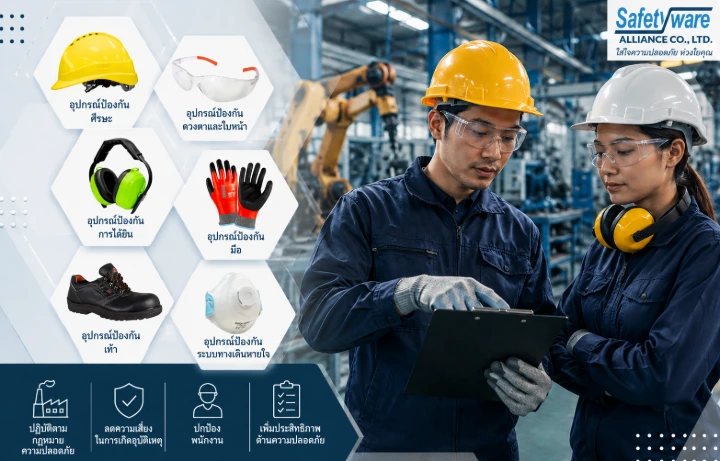
1. Safety Helmets ⛑️
Head injuries remain one of the most serious workplace hazards in industrial environments. Falling tools, suspended loads, low ceilings, and accidental impacts can all cause severe injuries.
Safety helmets are designed to absorb impact forces and reduce the risk of traumatic head injuries. Employers should ensure helmets are certified according to recognized international standards and are inspected regularly for damage.
At Safetyware Alliance, we offer a comprehensive range of Safetyware® Safety Helmets designed for industrial applications. Our helmets combine durability, comfort, and reliable protection, making them suitable for manufacturing plants, construction sites, warehouses, and other demanding work environments.
Suitable for:
- Manufacturing plants
- Warehouses
- Construction projects
- Logistics operations
- Maintenance work
2. Safety Eyewear and Face Protection 🥽
Eye injuries are among the most common workplace incidents in manufacturing. Flying particles, sparks, molten materials, chemicals, and dust can all damage workers' eyesight within seconds.
Depending on the application, employers may require:
- Safety glasses
- Safety goggles
- Face shields
- Welding helmets
High-quality eye protection should provide impact resistance while maintaining clear visibility and long-lasting comfort.
Safetyware® Protective Eyewear is designed to deliver reliable eye protection across a wide range of industrial environments, helping workers stay protected without compromising comfort during extended shifts.
3. Safety Gloves 🧤
Hands are involved in almost every manufacturing task, making them particularly vulnerable to workplace injuries. However, no single glove is suitable for every application.
The appropriate glove depends on the specific hazards involved.
⚜️ Cut-Resistant Gloves
Ideal for workers handling sheet metal, glass, sharp tools, or metal components.
⚜️ Chemical-Resistant Gloves
Suitable for handling solvents, acids, cleaning chemicals, and hazardous substances.
⚜️ Heat-Resistant Gloves
Designed for workers exposed to hot surfaces or high-temperature processes.
⚜️ Disposable Gloves
Widely used in food manufacturing, cleanrooms, laboratories, and pharmaceutical industries where hygiene is critical.
Safetyware Alliance supplies a comprehensive range of Safetyware® Safety Gloves, enabling businesses to select hand protection based on the unique risks of each work environment rather than adopting a one-size-fits-all approach.
4. Safety Footwear 👟
Foot injuries can occur due to falling objects, heavy equipment, punctures, slippery surfaces, or electrical hazards. Wearing ordinary footwear in industrial environments significantly increases these risks.
Industrial safety footwear should provide features such as:
- Steel toe or composite toe protection
- Slip-resistant outsoles
- Penetration-resistant midsoles
- Oil-resistant soles
- Anti-static or electrical hazard protection
- Comfortable support for long working hours
For workplaces requiring dependable foot protection, RHINO SHOE® Safety Footwear, a trusted brand under the Safetyware Group, is engineered to deliver durability, comfort, and certified protection for demanding industrial environments. From manufacturing plants to warehouses and logistics operations, RHINO SHOE® helps workers stay protected throughout their shifts while reducing fatigue.
5. Respiratory Protection 😷
Airborne contaminants are a common concern in many manufacturing environments. Dust, fumes, smoke, vapours, and fine particles generated during daily operations can pose serious health risks when inhaled over time.
Industries such as metal fabrication, woodworking, food processing, pharmaceuticals, chemical manufacturing, and construction materials production often require appropriate respiratory protection to reduce worker exposure to harmful airborne substances.
Common respiratory protective equipment includes:
- Disposable particulate respirators
- Half-face respirators
- Full-face respirators
- Replaceable filter cartridges
- Powered Air Purifying Respirators (PAPR) for high-risk environments
Employers should ensure respirators are selected based on the identified workplace hazards, fit-tested where applicable, and regularly maintained.
At Safetyware Alliance, our Safetyware® Respiratory Protection solutions are designed to provide reliable protection while ensuring comfort for extended wear, helping businesses maintain safer working environments.
6. Hearing Protection 🦻
Noise-induced hearing loss remains one of the most common occupational health issues in manufacturing. Continuous exposure to loud machinery can permanently damage hearing if appropriate protection is not provided.
Common high-noise work areas include:
- Press machines
- Metal stamping
- CNC machining
- Grinding operations
- Compressors
- Generators
- Production lines
Suitable hearing protection may include:
- Earplugs
- Earmuffs
- Electronic hearing protection for specialised applications
Safetyware® Hearing Protection products are designed to help reduce noise exposure while maintaining comfort, allowing employees to work safely throughout their shifts.
7. Protective Clothing 🦺
In many manufacturing environments, employees require more than standard workwear. Protective clothing helps reduce exposure to chemicals, sparks, heat, dust, and other workplace hazards.
Depending on the industry, employers may provide:
- Protective coveralls
- Chemical-resistant suits
- Flame-resistant clothing
- High-visibility safety vests
- Disposable protective garments
Selecting suitable protective clothing should always be based on a workplace risk assessment rather than applying the same solution across different departments.
Safetyware Alliance offers a wide selection of Safetyware® Protective Apparel designed to support safety requirements across manufacturing, logistics, chemical processing, food production, and other industrial sectors.
8. Fall Protection Equipment ⚠️
While fall protection is commonly associated with the construction industry, many manufacturing facilities also require employees to work at height during maintenance, equipment servicing, warehouse operations, or platform access.
Where working at height cannot be avoided, employers should provide appropriate fall protection equipment such as:
- Full-body harnesses
- Shock-absorbing lanyards
- Self-retracting lifelines
- Anchorage connectors
- Horizontal and vertical lifeline systems
Proper inspection, training, and equipment maintenance are equally important to ensure fall protection systems remain effective.
How to Conduct a PPE Hazard Assessment?
Providing PPE should never be a one-size-fits-all approach. Every manufacturing facility has unique processes, equipment, and hazards that require careful evaluation.
A comprehensive PPE hazard assessment should include:
1️⃣ Identify Workplace Hazards
Review every work area and identify potential risks such as impact, chemical exposure, noise, airborne contaminants, heat, electrical hazards, and moving machinery.
2️⃣ Evaluate Risk Levels
Determine the likelihood and severity of each identified hazard.
3️⃣ Select Appropriate PPE
Choose PPE that is suitable for the identified risks while complying with relevant safety standards.
4️⃣ Train Employees
Ensure workers understand:
- When PPE is required
- How to wear it correctly
- How to inspect it
- How to maintain it
- When to replace it
5️⃣ Monitor and Review
Regular workplace inspections help ensure PPE remains effective as manufacturing processes evolve.
‼️Common PPE Mistakes Employers Should Avoid
Despite investing in PPE, some businesses still experience preventable workplace incidents due to poor implementation.
Common mistakes include:
- Selecting PPE based solely on price
- Providing the same PPE for all job roles
- Neglecting PPE inspections
- Failing to replace damaged equipment
- Insufficient employee training
- Allowing incorrect PPE usage
- Ignoring employee comfort and fit
- Purchasing non-certified safety equipment
Choosing certified, high-quality PPE not only improves protection but also encourages employees to wear their equipment consistently.
PPE Maintenance and Inspection Best Practices ✅
Providing PPE is only the first step. Regular maintenance and inspections help ensure protective equipment continues to perform effectively throughout its service life.
Employers should establish routine procedures to:
- Inspect PPE before each use
- Replace damaged or expired equipment
- Clean reusable PPE according to manufacturer guidelines
- Store PPE in clean and dry environments
- Keep inspection and replacement records where appropriate
Well-maintained PPE offers greater reliability while helping businesses minimise unnecessary replacement costs.
❓Why Investing in Quality PPE Benefits Your Business
Many employers view PPE as a regulatory requirement or operational expense. However, investing in high-quality PPE delivers long-term business benefits beyond compliance.
Quality PPE can help businesses:
- Reduce workplace injuries
- Minimise lost-time incidents
- Improve employee confidence
- Enhance productivity
- Protect company reputation
- Lower compensation and insurance costs
- Support business continuity
When employees feel safe, they can focus on their work with greater confidence and efficiency.
Why Choose Safetyware Alliance?
Selecting the right PPE supplier is just as important as selecting the right PPE.
At Safetyware Alliance, we understand that every workplace has unique safety challenges. Backed by decades of industry experience, we provide comprehensive industrial safety solutions tailored to the needs of manufacturers across Thailand.
Our commitment goes beyond supplying products—we help businesses build safer workplaces by providing reliable PPE solutions that support employee protection, operational efficiency, and workplace safety compliance.
Frequently Asked Questions (FAQ)
Yes. Employers are responsible for providing appropriate PPE based on workplace hazards and ensuring employees understand how to use it correctly.
There is no single "most important" PPE. The appropriate equipment depends on the specific hazards identified through a workplace risk assessment. Common PPE includes safety helmets, gloves, safety footwear, eye protection, respiratory protection, and hearing protection.
PPE should be inspected regularly and replaced whenever it becomes damaged, worn out, contaminated, or reaches the manufacturer's recommended service life.
Even the highest-quality PPE cannot provide adequate protection if employees do not wear, maintain, or use it correctly. Regular safety training helps ensure PPE is used effectively.
Businesses should choose trusted suppliers that provide certified products, technical expertise, and solutions tailored to different industrial environments. Safetyware Alliance offers a comprehensive range of industrial PPE and workplace safety solutions to support manufacturers across Thailand.
Protect Your Workforce with Trusted PPE Solutions
Creating a safe workplace starts with choosing the right Personal Protective Equipment.
At Safetyware Alliance, we provide a comprehensive range of certified Safetyware® PPE and RHINO SHOE® Safety Footwear to help manufacturers across Thailand protect their employees, reduce workplace risks, and support compliance with workplace safety standards.
Whether you are equipping a new production line, upgrading your existing safety programme, or looking for industry-specific PPE recommendations, our team is ready to help.
Explore our industrial safety solutions today and discover how Safetyware Alliance can help you build a safer, smarter, and more productive workplace.