Thailand Workplace Safety Regulations 2026: What Employers Must Know
Thailand’s industrial and manufacturing sectors are growing faster than ever. With more factories, warehouses, and construction projects operating across the country, workplace safety in Thailand has become a top priority for every employer — not just a legal formality.
In 2026, the Ministry of Labour continues to enforce the Occupational Safety, Health and Environment Act (OSHA) B.E. 2554, supported by updated Ministerial Regulations that set clearer standards for hazard management, PPE, safety officers, and emergency response.
👉 Whether you run a small factory in Chonburi, a logistics hub in Bangkok, or a construction project in Rayong — understanding Thailand workplace safety regulations is essential for protecting your people and keeping your business running.
Why Workplace Safety Compliance Matters
Workplace safety is not only about legal compliance — it also directly impacts productivity, employee wellbeing, company reputation, and operational efficiency.
Companies that fail to implement proper safety measures may face:
- Accidents and injuries that shut down production
- Fines and penalties from Ministry of Labour inspections
- Temporary or permanent business suspension
- Criminal liability for directors and management
- Loss of employee trust and high staff turnover
- Damage to company reputation with clients and partners
On the other hand, organizations with strong safety cultures often experience:
- Fewer incidents and lower insurance costs
- Higher employee confidence and retention
- Better audit readiness and smoother government inspections
- Stronger competitive positioning — especially with MNC clients who require ISO 45001 or equivalent
As Thailand's industrial sector continues to attract foreign investment and raise its standards, workplace safety compliance is increasingly a business advantage, not just a legal obligation.
🗝️Key Workplace Safety Regulations in Thailand
Thailand’s Occupational Safety and Health framework is built around three main pillars:
- Occupational Safety, Health and Environment Act (OSHA) B.E. 2554
- This is the foundational law covering all employers in Thailand, regardless of industry or company size. It defines employer duties, employee rights, and the overall compliance framework administered by the Department of Labour Protection and Welfare (DLPW).
- Ministerial Regulations under OSHA
Sector-specific rules that govern high-risk areas including machinery and cranes, boilers and pressure vessels, chemical handling, electrical systems, construction sites, and noise and heat exposure limits. - Factory Act
- Additional obligations for factory operators, including mandatory risk assessments, hazard identification, and reporting requirements specific to manufacturing environments.
Under these regulations, every employer in Thailand is legally required to:
- Provide and maintain a safe working environment
- Identify, assess, and document workplace hazards
- Supply suitable and certified Personal Protective Equipment (PPE)
- Deliver safety training to all employees — before they start and on a regular basis
- Prevent occupational accidents and report incidents to authorities
- Maintain emergency preparedness plans and conduct drills
- Monitor workplace risks and track corrective actions
- Appoint qualified Safety Officers appropriate to their business size and industry
Industries such as manufacturing, construction, oil & gas, logistics, food processing, and chemical handling often face stricter safety requirements due to higher operational risks.
Safety Officer Requirements: What Every Employer Must Arrange
One area that government inspectors focus on closely is whether employers have properly appointed Safety Officers (เจ้าหน้าที่ความปลอดภัยในการทำงาน — จป.) as required by the 2022 Ministerial Regulation on Safety Officers.
There are three levels of Safety Officers, and the number and level required depend on your workforce size and industry risk category:
Safety Officer Level | Main Responsibilities |
Management Level | Setting safety policy, allocating safety budget, overall compliance oversight |
Supervisor Level | Daily floor safety, hazard identification, monitoring employee behavior |
Professional/Technical Level | Detailed safety audits, risk assessments, regulatory reporting |
Failing to appoint the required Safety Officers is a direct violation of Thai OSHA — and one of the most common findings in Ministry of Labour inspections, resulting in fines or suspension orders.
⛑️PPE Requirements for Employees
Personal Protective Equipment (PPE) is one of the most visible and most inspected aspects of Thailand workplace safety compliance. The law is clear: employers must provide PPE appropriate to the hazard — and ensure employees actually use it.
Depending on the work environment, employers may need to provide:
- ⛑️ Safety helmets
- 👟 Safety shoes
- 🧤 Safety gloves
- 🥽 Eye protection
- 😷 Respiratory protection
- 🦻 Hearing protection
- 🦺 Protective clothing
- 🧗Fall protection equipment
Employers must ensure all PPE is:
- ✅Suitable for the specific hazard and job task
- ✅Properly stored, maintained and in working condition
- ✅Regularly inspected
- ✅Replaced immediately when worn, damaged or expired
- ✅Used correctly by every employees
Failure to provide proper PPE can significantly increase workplace accident risks.
**Keep purchase records, inspection logs, and employee acknowledgment records ready at all times.
⚠️Common Workplace Hazards in Thailand Industries
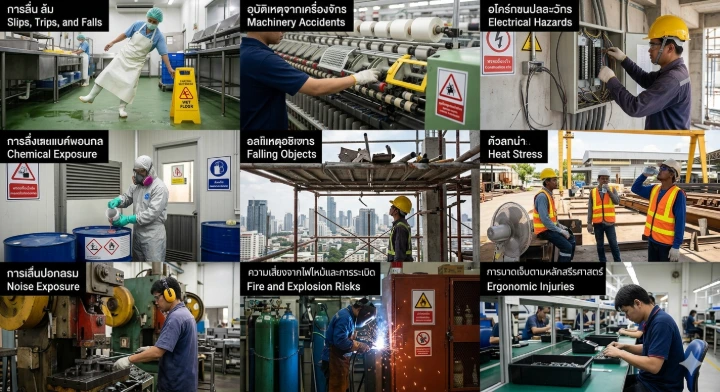
Understanding the hazards specific to your industry helps you build a more targeted and effective safety program. Across Thailand's industrial landscape, the most commonly encountered workplace hazards include:
- Slips, trips, and falls
- Machinery accidents
- Electrical hazards
- Chemical exposure
- Falling objects
- Heat stress
- Noise exposure
- Fire and explosion risks
- Ergonomic injuries
Manufacturing and construction remain the two sectors with the highest workplace accident rates in Thailand. Structured safety management systems are not optional in these environments — they are essential for protecting workers and passing government inspections.
Why Safety Training Is Non-Negotiable Under Thai Law?
PPE protects the body. But training protects the mind. Under Thai OSHA, safety training is a legal obligation — not a nice-to-have.
Regular safety training helps employees:
Regular safety training helps employees:
- Recognize workplace hazards
- Use PPE correctly
- Respond during emergencies
- Follow safe operating procedures
- Reduce unsafe behaviors

Many organizations now conduct:
- Safety induction training
- Fire drill exercises
- Hazard communication training
- Chemical handling training
- Emergency response simulations
A well-documented training program also serves as crucial evidence during government inspections. Keep attendance records, training materials, and assessment results properly filed.
‼️Penalties for Non-Compliance: What Employers Face Under Thai Safety Law
This is what most employers want to know — and need to take seriously.
Under Thailand's workplace safety regulations, non-compliant employers face:
- Fines
For documentation failures, inadequate PPE, missing Safety Officers, or failure to conduct required training - Business suspension
Operations can be ordered to stop following a failed safety inspection - Criminal liability
Where negligence causes serious injury or death, company directors and management face personal criminal charges under Thai law - Repeat inspection flags
Businesses found non-compliant are placed on priority inspection lists
The Department of Labour Protection and Welfare (DLPW) conducts both scheduled and surprise inspections. Inspectors look at three things above all: your documentation (records, logs, assessments), your PPE (availability, condition, and actual use), and your Safety Officers (appointed, qualified, and active).
How Businesses Can Build a Stronger Safety Culture in 2026
Going beyond minimum compliance is increasingly important — especially for businesses supplying to multinational companies, government projects, or export markets that require certified safety standards.
👍 Recommended best practices include:
- Conducting regular workplace inspections
- Performing risk assessments
- Using quality-certified PPE
- Encouraging safety reporting
- Digitizing EHS management processes
- Monitoring safety KPIs
- Establishing clear safety policies
- Conducting regular safety audits
Digital EHS platforms are also becoming more popular in Thailand as businesses seek better visibility into incidents, inspections, corrective actions, and compliance records.
Workplace Safety is a Long-Term Business Investment
Workplace safety SHOULD NOT be viewed as a short-term compliance requirement. A strong safety culture protects employees, reduces operational risks, and supports sustainable business growth.
As workplace safety regulations in Thailand continue evolving, businesses that prioritize safety management and compliance will be better positioned for long-term success.
Investing in proper PPE, employee training, and workplace safety systems can help organizations create safer, more productive working environments.
❓Frequently asked questions (FAQs)
The primary law is the Occupational Safety, Health and Environment Act (OSHA) B.E. 2554, enforced by the Department of Labour Protection and Welfare under the Ministry of Labour. It is supported by Ministerial Regulations covering specific hazards, industries, and types of machinery. Factory operators must also comply with the Factory Act and its associated risk management requirements. In 2026, the Ministry of Labour has placed particular emphasis on proactive prevention, stricter PPE documentation, and proper Safety Officer appointments.
Yes. Under Thai OSHA, employers are legally required to provide appropriate PPE for all employees who are exposed to workplace hazards. The specific PPE depends on the nature of the hazard and work environment. Employers must also ensure PPE is maintained, inspected, and correctly used — and keep records to prove it.
Manufacturing, construction, oil & gas, chemical processing, food production, and logistics are subject to additional Ministerial Regulations beyond the standard OSHA baseline. Factory operators have further obligations under the Factory Act, including mandatory hazard assessments and documented safety plans.
Penalties range from fines for documentation and PPE failures, to business suspension following failed inspections, to personal criminal liability for directors and management where negligence results in employee injury or death.
The required number and level of Safety Officers depends on your workforce size and industry classification under Thai law. Some businesses with as few as 2 employees in high-risk categories may already need to appoint a Safety Officer. Larger establishments typically need officers at the Management, Supervisor, and Professional levels. Consult a licensed safety consultant or the DLPW to confirm your specific requirements.
🔎 Ready to Strengthen Workplace Safety in Your Organization?
Whether you manage a factory, warehouse, construction site, or industrial operation in Thailand, SafetyWare Alliance provides a full range of industrial PPE and workplace safety solutions — designed to help Thai businesses meet 2026 compliance requirements with confidence.
Get in touch with our team to discover the right safety solutions for your industry.